Joyce Brumbaugh is a music lover and writer from Kalamazoo, Michigan.
That’s where two of my Gibson guitars were made around the time I was born.
Joyce is currently putting together a biography of Orville Gibson.
She asked if I wanted to talk about my guitars and music and I was happy to comply.

I’ve been listening to Ad Vanderveen’s music for close to 25 years. Back in 2000-ish, he and Iain Matthews were touring Europe. I had been to several of Iain’s solo shows in the 90s when he was in Michigan. I was also a member of one of his fan sites. It was Iain who put me in ’email’ contact with Ad because we both love Neil Young’s music. Of course, I started buying up his CD’s. I remember each time folding a twenty-dollar bill into a note telling him which album I wanted. Ad was born and raised in the Netherlands, but he had relatives in the Great Lakes region of Canada and often ventured into Michigan. He told me that he would have occasion to use the foreign currency.
Ad is an exceptional guitar player. He’s no slouch on the piano, either. The thing that stands out to me, is that there is as much to listen to in his playing as there is in his lyrics. His voice, his instrumentation and his songwriting are a nicely balanced package. He also knows how to make distortion his bitch. I never tire of it. I’m guessing it’s the unapologetic reverberation that those hollow bodies deliver.
Something else that drew me to his music was that he writes about difficult situations. Though the topics may differ between men and women, that need to feel unencumbered is universal. Several years ago, I found myself in a new and difficult to navigate situation. I put on ‘Wonders of the World’ thinking about how I hadn’t listened to it in a while. I’ll be damned if the first song wasn’t ‘Start a New Life.’ Many of his songs are like guardrails. On a rocky and uncertain path? Listen to him. He’ll tell you his stories.
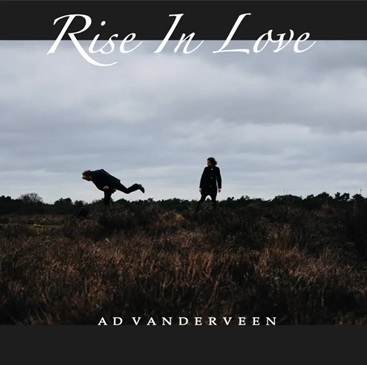
Ad released a new album this past April called ‘Rise in Love.’ I listened to it for the first time while working on my writing. I particularly like “Can’t Cross Over,” “Good Life,” and “Best for Last.” Like an old friend, I recognized the opening notes of “Forgiveness.” I put my pen down to listen. His songs have held up well over the years and he continues to do good work
Since Ad plays both electric and acoustic Gibsons, I thought I would ask him about them. Here’s what he had to say…
Joyce: I think I’ve asked you this before, is that your mom on “Train?” I smile every time I play that track.
Ad: No, that’s Timon, our guitar player’s young kid who was in the studio. He was yelling and I remember we liked the vibe on the track so we kept it on there.
Joyce: That’s great. I think Timon was channeling my mom when she would yell down the basement stairs at my brothers. There are readers who will take one look at the cover photo of The O’Neils and know exactly what model Gibson you’re playing. For the rest of us, would you tell us about that guitar? How often do you use it on your other material?
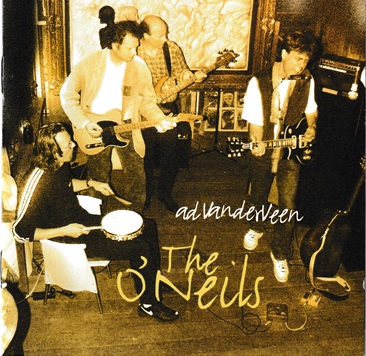
Ad: That’s a Les Paul standard. It’s a pretty straight forward off the rack guitar from the early 80s and it has served me well for the loud parts of my music. It’s funny on a studio session in Nashville once they told me it sounded like a Gretsch, which they didn’t know is what I mostly play. I guess that sound is in my head and hands. I put Filtertron pick ups on the Gibson later to make it more compatible with my old Gretsch. For the O’Neils loud garage band stuff, the Les Paul is best. It’s in its case now since the last loud gig more than a year ago, still sweaty and with broken strings and all. I won’t do that anymore and will preserve what is left of my hearing for acoustic stuff. I suppose there will be a place for the Gretsch in the future still, it blends well with acoustic based music.
Joyce: I like your use of distortion on songs like “Crazy Moon.” The effects vary and are not one dimensional. Plus you seem to really lean in to it. I’m glad you’re taking care of your hearing. A word of caution, if any readers out there play the reprise of “14 turns 41” on their laptop, turn the volume down first. Those tiny speakers won’t know what hit them. What is it that you like about Gibsons? What qualities and features do you look for?
Ad: Yeah for me, if it’s electric I want it to be dirty. I love to improvise that way, forget about time and get a little free and crazy with feedback and all. It gives release to something I can’t express any other way, I guess it’s anger. As a vocalist I’m mellow but with the electric I can scream. I’ve realized at times that the timbre of that tone is like a violin, I love playing with violin and harmonizing with my friend Neil James Morrison on fiddle. It has been one of the pleasures of my life.

Speaking acoustics, I’ve gravitated toward Gibsons ever since they gave me an endorsement deal in Nashville in ’91. I got a great deal on a very fancy Jumbo then, which kind of became my starting capital. I’ve traded and owned quite a few guitars since then, also Martins and some boutique brands. I love the sound of a good Martin in someone else’s hands but for myself Gibsons generally fit better. I once heard a comparison that a Martin is like a grand piano and a Gibson is like an upright. That makes sense, although my Gibsons can take on any Martin, too. I don’t like the thought of being loyal to a brand, guitars are individual. But to illustrate with a little story: once when I was touring in the US with Iain Matthews, my guitar got broken on the flight. So I had to go and get one and realized that not any guitar would do. It’s not simple when you’re a lefty, we went to Guitar Centers and what have you and soundcheck was at 17.00, so at gunpoint I had to decide. With so little time to compare I headed for the Gibson corners. I came away with a nice J185 from a store outside of Philly that I’ve played for 18 years. But this goes to show that Gibson is instinctively my first choice.
Joyce: Do you remember what venue you played in Philly? Back in the mid 90s, I saw Iain at an old brick coffeehouse called ‘The Point’ in Bryn Mawr, a few miles northwest of the city. It was a wonderful place, except they had a blender from hell. The bartenders were considerate enough not to use it during a song, but the second it ended we all knew that blender would go off. It sounded like all the parts and pieces were about to come loose and fly across the room.
Ad: Exactly, that’s the one. I believe it used to be called ‘The Main Point’. I used to listen to bootlegs by Jackson Browne and David Lindley that were recorded there and felt thrilled to play that place. Just across the road was a guitar store called Medley Music where I bought that J185.
Joyce: Do you have a favorite guitar shop that you buy from?
Ad: Not really, I take them where I find them. Being a lefty narrows the choice so I’ve always been alert, sort of. Now I’m covered, I pared down and traded in all very good guitars for 2 really great ones. I also realized there’s less time to wait until instruments age so I got one that’s my age, which is Ol’ ’56. We have a great match. Also I have another ’56 Kalamazoo, it’s an LG 3/4 that I use for high strung Nashville tuning and it sounds terrific. I love the mahogany old Gibson sound, crisp, woody, thumpy and shimmery. How do you describe sound? I love the sound of a good rosewood to listen to, but to play I prefer mahogany.
Joyce: Absolutely. It amazes me what truly creative people can produce from only the basics. As far as sound, I play an Alvarez that has a naturally mellow sound to it. I want strings that are not too tin-y, not too marshmallow-y.
Ad: Well so do you, from what I’ve heard. I thought you’d be playing a Gibson there.

Joyce: Oh, my goodness. Thank you. My Alvarez is a 1976 that I bought new in 1978 from a local guitar shop. I heard someone else play theirs and thought it was a good tone for my timid voice. Mellow and round-y without any sharp edges. I love it. Orville forgives me, sort of, not really. Maybe I should buy a Gibson before I go out on any speaking engagements for my book. Anyway, tell us about “Ol’ 56?”
Ad: Ol’ 56 is a J50, which is blonde. It’s my go-to for recording and writing, and sometimes I take it out to gigs as well. My main road guitar is a J45, which is sunburst. It is modeled after a 1942 version, sounds great and is easiest for amplified situations.
Joyce: You’ve recorded with a mandola. Many bands go through a mandolin phase. R.E.M., Bill Monroe (I’m joking!). Maybe it suited your vocal range better? Tell us about it.
Ad: I traded in a Guild 12 string for a lefty mandola and banjo and really got to enjoy a discovery trip during the pandemic. I got very pleasantly lost and found on the mandola and it turned into songs. It’s a very inspiring sound and the 5ths tuning led to some surprising changes. Usually, words lead the way for me but I suppose the mandola bedding made things ring differently. But in general, a 6 string acoustic in standard or drop D tuning make my days just fine. It’s amazing how those simple chords and sounds keep bringing magic and continue to fascinate me.
Joyce: That’s an inspiring story. Thank you for that. I would have loved to have attended a show when you opened for Van Morrison. I’ve read that he has long suffered from stage fright. I have as well. I remember seeing him on David Letterman after many years absence from recording. He shook so badly he had trouble holding his guitar. What did you take away from being so close to him and his music?
Ad: As a long time fan, I felt greatly honored to get his personal invitation. I had a great time, it was at an old palace where the royal family used to live and we got to use their old cinema as our dressing room, with all their stuff still laying around there. I met Mr. Morrison briefly in the halls before he went on stage and thanked him. He struck me as being vulnerable and kind. I saw his other side when he scolded his bass player onstage. I think he has a lot of pressure on him, which is what a certain status brings. I felt lucky to travel light and have little machinery to answer to and take care of.
Joyce: Oh, dear. Yes, that kind of scolding is uncomfortable for the audience to witness. I’ve seen it and heard stories of other big-name performers doing that. I’ve read that after your early bands, you hadn’t planned on becoming a vocalist. I want to mention that Nat King Cole hadn’t planned on being a vocalist, either. He had to be talked into it. Is there anything you miss about playing without having to carry any vocals?
Ad: I’m a songwriter-singer, so to speak. I sing because I write and couldn’t depend on others to make my songs come to life. I’ve started enjoying it more and more over the years and couldn’t imagine going without it now. I wish I had someone who could carry my tunes on guitar the way I do myself. That would free me up to play and improvise. It’s a very important and under-estimated role, that of rhythm guitarist. But as for folky acoustic stuff I’m very happy to be self sufficient.
Joyce: What have you been up to lately?

Ad: I’m just back from a trip to Spain where I wrote two and recorded ten new songs in all. I had my Gibson LG American Eagle with me, which is my travel guitar. It sounded great recording in a room with a nice ambience and windows all around, one side facing the ocean and the other overlooking the Camino de Santiago. Every day I would look at the pilgrims walking by and talking to some of them it was inevitable that I got a song about that. Now I wonder what I’ll do with this bunch. Part of me wants to put it out as is, but maybe some additions will be made and who knows if a suitable producer would step in it could evolve further.
My problem is that I’m too productive, even though half a year can go by that I don’t write, before I know I find myself with a group of songs that wants to go somewhere. I just have the new Rise In Love album out and took a long time with the recording of that to give some space to the previous one. But the Muse just won’t wait and when it comes knocking I have to answer. So here I am with a new collection that seems to have its own distinct unity and vibe. I try to stretch it because you can’t knock on the same doors too often, people can’t keep track. Going by the timing and dictates of any music business is very discouraging and counter-creative, so I have to remind myself every time why I do this and who for. I don’t expect anyone to keep up,
I do it for the love of it, for myself, and fortunately there’s a small group of dedicated followers. Anyway there’s always a delay before an album materializes so we’ll see what happens.
Joyce: Ah, that’s something you have in common with Neil Young. I’ve heard that if he never writes another word he could still release new material for the next twenty years. I, for one, would like to thank you for not being able to give in to a formulaic process. All that human-ness feeds the soul. It gives our ears lots to listen to and our hearts lots to mull over. I’ll keep an eye out for a tour date near me. Thank you for your time, Ad.
Ad: Thanks for having me Joyce!
___________________________________________________________
Several great song downloads can be played on this site at https://joycebrumbaugh.com/the-oneils/. Throw open the windows and turn it up.
.Ad Vanderveen’s music can be purchased from his website at https://advanderveen.com/store/. You’ll also find a download of his latest album ‘Rise in Love’ at https://advanderveen.bandcamp.com/album/rise-in-love. His music videos are here https://advanderveen.com/video/. Many of his songs are also on YouTube at https://www.youtube.com/@SongsenseMusic .
I’ve recorded two of Ad’s songs, “First Feeling” and “Old Friend,” along with an Iain Matthews song that can be found here https://joycebrumbaugh.com/in-the-studio/
Author website:http://joycebrumbaugh.com
 Ad Vanderveen
You must be logged in to post a comment.